
Samuel Rose Parkinsn 1831 - 1919
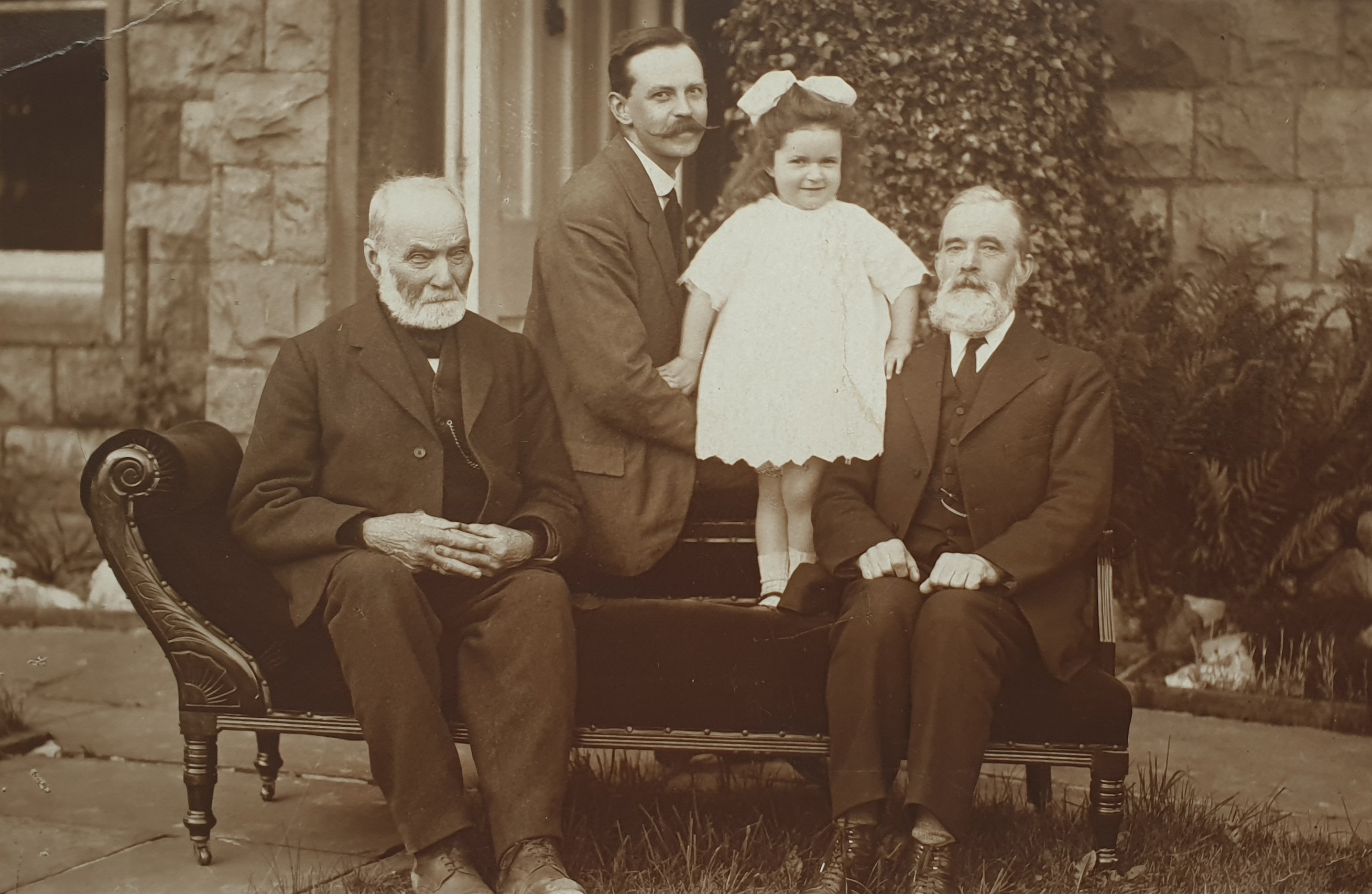
The photgraph below shows 4 generations: James, left, b1829 in Chatburn. He was my gg grandfather. The others are his son, Henry; grandson, Ernest and Gladys, gg granddaughter. James and Samuel Rose were first cousins, making me first cousin 5x removed from Samuel Rose.
Samuel Rose first Journal 1831-1876

Samuel Rose first Journal 1831-1876 by his son William C. Parkinson.
[ Note: This is volume 1 of the journals of Samuel Rose Parkinson, which go from 1873 to 1919. Most the originals are in the LDS Church Archives. The background account, written in 1873, covers Samuel's first 42 years, after which his daily entries begin. Additions to the summary portion in Samuel Rose Parkinson's hand are in {curly brackets}. Background account transcribed and proofread by Jared and Ben Parkinson, March 2002. Daily entries 1873–76 transcribed and proofread by Mark Brady, January 2006.]
Samuel Rose Parkinson - Journal Book
Apologies - In the first paragraph I have corrected spelling mistakes to make it easier to read. Place names have been corrected. I too grew up in Barrowford, Nelson.JH
I was born in Barrowford, Lancashire, England on April 12th 1831. My father William Parkinson died when I was 6 months old. Later my Mother moved to Stockport, Greater Manchester, Lancashire and taught in a school for a living. In 1835 my mother married Edmond Berry, a coal Merchant. In 1839 my father and family emigrated to Australia. We set sail on a Friday and called in at St. Jags to get fresh water, but they would not let us have any, except we stayed there 8 days. The captain would not stay longer so he hoisted the anchor and set sail on Friday. We sailed to the Cape of Good Hope. There we cast anchor, took in fresh water and cattle and some Cape sheep. The tails of these are about 2 ft. long, and 1 ft. wide, across the middle. We also took quite a lot of poultry. We set sail on Friday and landed in Sidney Town six months later. in the year 1840 my father was a lime Merchant in Sidney Town and did well. My mother and I started a grocery store and made money.
End of proofing, original below.
I was Born in Barrowford Lancaster England April 12th
1831; my Father William Parkinson died when I was 6 months old; then my Mother
moved to Stockport Lancaster, and taught {s}chool for A liveing; in the year
1835 my Mother got Married to Edmond Berry; he was A coal Merchant; in the year
1839 my Father and Family emigrated to new Austrillia; we set sail on Friday,
and call in at St. Jags to get fresh water, but they would not let us have any;
except we Stay there 8 days; but the captain would not, so he hoisted the
Anchor and set sail on Friday; we Sail to Cape of good hope, there we [p. 2] cast Anchor on Friday; we took in Fresh
water and cattle, some cape sheep, the tails of these are about 2 ft. long, and
1 ft. wide, across the medle, we took quite A lot of polterry; and set sail on
Friday; we landed in Sidney Town on Friday; we was six month on the way; in the
year 1840 my Father was A lime Merchant in Sidney Town {and done well}; my
Mother, and me Started A grocerry Store {and made money};
In the spring of 1843 my Father started a Brick yard; he lost about all we had made; so he got discouraged and emigrated to new Zealand; he did not like new Zealand, so he paid his fare on the same ship to Valparaso, South America. My Father got a good berth on the English water works; he was put in boss over the whole affair; I went to school 6 months; in the year 1844, I was interpreter of the Spanish Language for A Dentist; in the year 1845, I tended Store for an Iron Merchant.
In 1846 father emigrated to England. We had a rough time sailing round Cape horn; the sea broke our bulwarks in fore and aft; we was sailing one evening with a stiff Brize, and the sea froze over, and it was all the captain could do, to turn the ship around and sailed back all night; when we came up again, the ice had turned into icebergs, they had to stear through very careful. When we left South America; our captain bet a new hat, with another captain, that he would be in
England first, when we got round the cape horn, the captain Saw A ship behind he thought it A Pirate Ship so he heave to, and this captain sail right Along
side of {us}, and had A long talk with our captain; and then sail off and told our captain to remember the new hat; we sail in A heavy gail every day; until
we came to the coast of Ireland; and there we got ship wreck, but we got ashore safe, and travel over land to a seaport town; name Wexford, we took pasage to
Liverpool.
We took the train to Stockport Lancashire; there was no work to be got in the country; so father bought 2 cows, and I went around selling milk.
in the year 1847, Father moved to Blackburn; Father and me went to work on the Blackburn and Preston Rail Road; then we moved to Ratendale, and Bacup Rail Road, work there all summer and moved Back to Blackburn, and work on the Blackburn and Accrington Rail Road all winter; erly in the spring, Mother took me to see my relations. I saw one aunt. She lived at the foot of Pendle hill; we cross over to Downham side; there I saw an uncle, with a large family, bid them goodbye pass thru Downham; this uncle (Henry) last named got his liveing by farming; I saw another uncle beween Burnley and Barrowford; he owned a cotton factory, he gave me a half a crown I thought small Potatoes.
In the year 1848 we emigrated to St Louis Mo. there Father and me work in a Porkhouse all winter and; {I join the Church} we Saved money to send for my sister
Elizebeth; and her husband and Family; in the spring Father and me, got A job at A Flower mill, driveing team at $1.00 a day each; July 18th, 1849, my Mother died of cholera; the next winter Father got Married, in the spring 1850 I left home; as I and my Step Mother could not agree, about the children; I went to Board with Bro Clemings and I was out of work 2 or 3 weeks I got afread I could not pay my board bill but I got a job to drive team at $18.00 Board and washing per month I work 3½ month I saved $32.50 then I quit working by the month and bought me a horse and dray for $130.00 I paid 30 dollars down and got time for the balance and I paid the balance in six weeks during this time Father had move up the river to Lagrans Mo. and I had got home sick so I went up to see them I found they was all in helth but poor in circumstances so I told my Father how I was getting along he could hardly belive it but I told him if he would come down to St. Louis I would give him my team and A good mill to hall for where he could make from $15.00 to $25.00 per week So he took me up and moved to St. Louis, and I bought another team on time, I paid 230.00 dollars for it; in the winter Father got discourage because there was no work he wanted me to take the team back as he did not like to sell it because I had made him a present of it; he said he had no feed for his team nor his Family; so I told him to go home and cheer up; and I would bring him some, so I borrow some money, and bought him 2 barrels of flour, 1 hog, and 1 load of hay, and 1 load of corn, and I took it to him, and I told him when he got any more money; to keep it; and let his wife have a little at a time; I finish paying for my team in the spring of 1851; I work very hard and, some times I work every other night.
In the year 1852 I let my Father have a horse worth $75.00 for $40.00,then my Brother in law William Higgins, wanted me to give him a start in the world; so I sold him a team for $175.00, and he was to pay me as much as he could every week; he had the team 1 year and pay me $5.00; his excuse was that he could not do all kinds of work; so I lent him A mule So that he could do all kinds of work; and pay me for the team I had let him have, but he tried to swindle me out of the whole affair; so I put it into A lawer hands; and he got 1 mule back, he could not get any more because the law aloud him all he had left; in January 1st 1852 I got Married I had about $600.00 in the Bank. I started another team and made money all the time; February 23rd 1853 my son Samuel was Born; in this year my sister Lucy, and her Stept Mother could not agree; so she come to me, and I protected her, in the year 1854 I emigrated to Utah Territory; I brought my Sister with me; I cross the plains with a four mule team; I found Utah A hard place for me to live and save my team; untill I
got use to the ways of the cuntry; I turn my team out on the Range for the winter; I went to work for A. Alder and Shem Pernell, burning charcoal, in them Seders west of Ogden City; and hauled it to Kayvill; and me and Bro Robins got our winter wood of willow roots; down by the lake of kay vill; in the Fall I
bought A Bilden lot, and A set of house logs, so I went to work and Bilt me a log house; and moved in About the last of December 1854; in the Spring I bought me a piece of land, and put in a crop, and the grassoppers eat it all up; so I went to work on the fort wall in 1855 {my wife has twins William and Charlotte}; in the fall I contracted to run a threshing machine; as there was A little grain raise up North; So I made my bread and seed for another year; I traded my stove for another, and got a cow to boot.
In the Spring of 1856 I put in A crop of wheat; and went on a Mission to the Devil Gate for a load of ancarts goods; I turned out to be a general trader; in 1857 I put in A crop, {my son George was born on this year}, in the fall I went out to Echo canyon; to meet Johnson Army, I was with gerneral Wells until he came in to the valley; I then started on a Mission to Salmon Rivere; I was Sent back from Marsh Valley; in charge of a lot of wagons; when I got home, I put in my crop, and then the order came for every body to move South, So I moved South in companny with Christopher Layton and Geo. Allen; {in 1858} we travel west of
Utah Lake, we found out that the Indian was very hostile that way; so we turnvback, then the word came for every body to return to their homes; So I drove
home. I done conciderable traiding with the gentiles in the fall in the Spring of 1859 I put in A crop; in July 7th my son Franklin was
Born; in the Spring of 1860 I moved to chache Valley Franklin; we camp in what is known as the South feild; and then bro Maughn came up and held a meeting and appointed Bro Smart my self and Bro. Sanderson as A committee to give out the land and take charge of the place until there was A Bishop appointed So we went to work and surveyed the land and draw lots for it put in a crop work on water ditches most of the Summer in the fall I went to Sell {dry} goods for Parry & Co. Salt Lake City; Present Young came up appointed Preston Thomas Bishop; in 1861 we put in A crop and I had a team across the plains after the poor; and I started A dry goods {store;} done conciderable traiding; in the year 1862 my Daughter Easter was born; Sent A team across the plains after the poor; put in a crop and tended Store; I belong to the Minite Company, and I was out on every expedition; and we had A great amount of running every year; I work on public work a great deal; in 1863 I put in A crop; I Sent A team across the plains, every year they went and one season I sent 2 Wagons; in Aug
28th my son Albert was born.
In the year 1864 I put in A crop; and Bought A half of A chaf piler threshing machine; I help to guard Franklin from indians depridation a great deal; in
1865 April 18th my daughter Clarisa was Born; I farm it all that years, and bought {¼ of} a new Pitts theshing machine; I work on water
ditches, and Meeting House, {me and Bro Smart Bilt A Saw mill}, in the year 1866 I farm and run the Store all the time my daughter Caroline {was Born} Nov
10th; and I Married Charlotte Hayter Smart {in} December; in the year 1867 I farm, my daughter Ann was born October 15th; I took the theshing machine and run
it down rang Ogden and {done good Business;} in February 15th 1868 I Married Maria Hayter Smart I was farming and trading and I went freighting to Montanner.
In 1869 March 27th my Son Thomas was born Sept 7th my daughter Lucy was Born I sold dry goods and done considerable business I paid up 6 shairs in the coop store in the year 1870 I Farm and traded all this year I served as Constable for about 8 years. In 1871 I farm {my daughter Luella born Sept 22;} and traded in any thing horses cattle dry goods or grain in 1872 the stock holders of the store put me in a Director and Superintendent of the Store July 15th my son Joseph was Born; the {Store} when I took charge of it; was in dept $2,300 dollars I run it 1 year it was not oweing anybody then I was call on a mission to Arizona and I went my Journal commences April 12th 1873 in
that you will find it more correct I have wrote this down as near correct as I could recollect.
Biography of Samuel Rose Parkinson by his son William C. Parkinson.
Some incidents were added by his daughter Caroline [P. Goaslind]
Samuel Rose Parkinson was the son of William Parkinson and Charlotte Rose. He was born in the little town of Barrowford, Lancashire England, April 12, 1831. His father was a twister in a cotton factory and earned his living by daily toil. He was also a local preacher in the Methodist Church. On November 10, 1831, he died and was buried in the Wesleyan Methodist Church Yard, leaving his family, consisting of a wife, his 7 months old son Samuel, and a step-daughter by a former husband--John Duckworth--in a very humble circumstances. They had also buried a daughter, Susannah, on February 6 of the same year.
His mother was an educated, refined woman, born of wealthy parents in the County of Kent, near London. Shortly after her husband died, she moved to Stockport, near Manchester, where she taught school for several years, until she met Edmund Berry. He was a very worthy young man occupied as a coal merchant. They were married in 1835, residing at Stockport, where their family was increased by the birth of two daughters, Sarah and Lucy.
Owing to labor agitation about this time, Mr. Berry failed in business and as great inducements were then offered to colonists to settle in Australia, then a new country, in the spring of 1839 they started for that far-away land. They traveled from Manchester to Liverpool on the first railroad ever built in England, perhaps the first that history records.
They started from Liverpool in a sailing vessel in the month of April, sailing around the west coast of Africa and arriving at the Cape of Good Hope about July 30. They remained there eight days, taking on fresh supplies, among which were live cattle and Cape sheep. While here their daughter Ellen was born. Mr. Berry was the ship butcher and was allowed the offals from the animals which he killed, and which served for their meat supply. Their travels were rich in interesting experiences. On one occasion a child was thrown from the deck, by the wrenching of the vessel, into the water and a Newfoundland dog jumped after it. The Captain stopped and the ship and sent men in a lifeboat, to look for the child. They went a long distance and were about to return without the child when they heard a splash and saw the dog coming toward them with the child in its mouth. Child and dog were saved. While they were anchored at the Cape the company who owned the dog went ashore. They Captain detained the dog until they were some distance from the vessel and then turned him loose to see what he would do. He jumped in the water and swam toward his friends. While so doing he narrowly escaped being caught by a shark.
It seems a coincident but might be interesting to know that they left Liverpool on Friday; anchored at St. Jago on Friday; sailing the same day; anchored again at the Cape of Good Hope on Friday; set sail on the following Friday; headed for Australia, and arrived at New South Wales on the quarantine grounds on Friday about the last of September. Remained there until the following Friday; then set sail and arrived at Sidney on a Friday.
They left England because the men in the cotton factories went out on a strike. Mr. Berry continued to sell coal on credit thinking the men would soon go back to work, until he was reduced to poverty. England was offering inducements to settlers to go to Australia so he took advantage of the reduced rates. On arriving there he engaged in the occupation of lime burning, making lime from sea shells. Mr. Berry having charge of the business and receiving about fifty shillings a week. Mrs. Berry made hot rolls and muffins and Samuel arrived and carried them to the market where he sold them quite successfully. They finally added fruit and soon opened a green grocery and provision store. They kept the store about a year when Mr. Berry bought a brick yard and Samuel hauled sand and sold brick. Failure soon followed this venture.
They became discouraged and decided to sell out and go to New Zealand. They left Australia about October 1, 1842, and after six weeks arrived in Auckland; remained there about eight days but did not like the country, so they continued on the same ship to Valparaiso, South America, where they arrived about January 15, 1843. They were the first of the working class of English emigrants ever landed in that country. The Governor tendered them the soldiers' barracks where they lived temporarily, for about a month and then secured a home.
Samuel then engaged himself as a gardener for a Mr. John Martin, but was soon critically ill from a sun stroke. After he recovered he had charge of the English Water Works. His work was to save the rain water and conduct it into tanks where it was purified and made ready for household use. At this time he lived with one Reverend Armstrong who was a minister of the English Church. He did such chores as working in the garden; watering flowers, etc., and went to school in the middle of the day for six months. By this time he had learned the Spanish language, and went to work for a dentist as an interpreter. From there he got a situation as clerk in an iron store. He was then about 14 years old. While in South America his brother William was born in 1843. After three years residence in Valparaiso the family decided to return to England and set sail in the month of July. They sailed around Cape Horn and up the east coast of South America; across the equator and along the west side of Africa; back to Queenstown. As they were passing thru the English or rather the Irish Channel they ran between the mainland and Salter Island and were shipwrecked. Their life boats were lost but they put out distress signals and were rescued by some Irishmen who fired a rope over a cannon and by that rope a boat was drawn over to the ship and then back and forth until all the passengers were rescued. Mr. Berry and family were the first ones to be brought to land and were taken by wagons to Waxford and then to Liverpool on a steamer; from there by rail to Stockport. While they were passing around Cape Horn they encountered a very rough sea and many icebergs. Such a storm occurred that the bulwarks were all swept away level with the decks from the forecastle to the poop.
While in Valparaiso they were attacked by Spaniards who entered the house about dusk while Mr. Berry was sleeping and supposing the mother and children were along they attempted to rob the house. The mother screamed and when she refused to be quiet they struck her with a sword. She threw her arm up to protect her baby and received three cuts across the arm. Samuel tried to escape to inform the neighbors living close by and was knocked down, twice, but finally recovered from the shock and was able to bring the neighbors to the rescue. A blow on his head made by the sword caused a scar which he carried the remainder of his life. In the meantime Mr. Berry was awakened and seized a large iron key about two feet long and with this he cleared the house and shut the door only to find that the boy Samuel was missing. He threw the door open with his weapon in his hand, prepared to strike the first man who entered and at the same time a neighbor, a Mr. Givson, and Samuel reached the door supposing the Spaniards were still in the house. They were prepared with an ax to strike the first man who attempted to escape. The boy seeing that his father and Mr. Bigson were about to strike each other by mistake, jumped between them and prevented the blow which might have proved fatal to either one. The Spaniards soon retreated carrying with them some who were wounded. Samuel was taken to a doctor that evening where his wounds were attended to and he soon recovered.
On returning to Stockport in 1840, during the famine there and the failure in the potato crop in Ireland, he found that his grandfather Berry was dead and his relatives were all in destitute circumstances. He then had between five and six thousand dollars which he generously distributed among his relatives, who were in need. Among them was his step-daughter Elizabeth Duckworth, who had remained in England during the time they were abroad, and while they were absent she married Joseph Chappel. They had twin girls who dies soon after Mr. Berry and his family returned to England.
During the winter of 1846 and 1847 Mr. Berry bought two cows which Samuel cared for and then sold the milk. This was their only income until the following spring when Mr. Berry obtained employment with the Blackburn and Preston railroad. In April the family moved to Blackburn and two months later to Rawthenstall where they obtained employment on the Rawthenstall and Bakup railroad. In November the family moved again to a place they worked on the Blackburn and Ackrington railroad, until the spring of 1848, when they set sail on the ship Europia for North America. While in Caffold their daughter Elizabeth was divorced from her husband.
July first they arrived in New Orleans; October first they took the steamboat "Josh I. Lawrence" up to Mississippi River to St. Louis. During this trip their daughter Elizabeth married William Higgins; they went ashore to rent a house and the first family they met were Mormons. These people directed them to a vacant house next door to a Mormon family by the name of William Clements. In December 1848 Samuel was baptized into the Church of Jesus Christ of L. D. S. by Mr. Clements and was confirmed by Elder Felt. During the winter of 1848 and 1849, Mr. Berry and his son Samuel worked in a pork house and in the spring they obtained employment in the Park Flour Mill. In July the Cholera broke out and on July 18, 1849 Samuel's mother died. In August Elizabeth and her husband arrived in St. Louis. The men continued to work at the mill and the following Christmas Mr. Berry married a widow by the name of Thursa Booth. She was also a member of the Mormon Church.
In the spring of 1850 Samuel left home and began to work for himself. He obtained employment driving team at $18 per month and board. In three months he bought a team on credit and six weeks later had paid for it. He then paid a visit to his father at LaGrange, found him in poor circumstances, and induced him to move back to St. Louis, gave him a team and he obtained employment hauling for the United States Flour Mill. Samuel then bought another team on credit and continued to drive a team on the St. Louis Levy. By May, 1851, he had paid for his team and assisted in the support of his father's family. That spring one of Mr. Berry's horses became lame and Samuel gave him another one.
During this summer Samuel made the acquaintance of a young English girl who was a convert to the Mormon Church. This young woman, Arabell Ann Chandler and Samuel were married January 1, 1852. Encouraging prospects and good work made conditions look bright. Febrary 23, 1853, a son Samuel C. Parkinson was born and in June of 1854 the family and sister Lucy left for Utah. Took steamer to Fort Leavenworth and then they obtained supplies and prepared to cross the plains by team leaving July 10 in what was known as the St. Louis Co., consisting of about 60 teams. William Fields was Captain of the company which arrived in Salt Lake City September 23, 1854. Shortly after coming to Utah the family moved to Kaysville, Davis County, where they bought land; built a home of logs and remained there until the spring of 1860. During this time farming was their occupation. August the 2nd twins were born to the family, named Charlotte and William (1855). In the spring of 1857 Samuel went East as far as the Devils Gate on the Sweetwater and hauled in a load of goods left there the fall before by the handcart company. A few months later he went out to meet Johnson's Army returning some time in January or February. July 18th George C. Parkinson was born.
In the spring of 1858 he went on a mission to the Salmon River to help the people there to return to Salt Lake Valley, that they might be protected from the Indians. Missionaries were called home from all nations to protect their families. In the summer of 1858 the family moved south to Utah Valley camping on the west side of the Jordan River opposite Lehi, returning home to Kaysville the following fall. July 7, 1859, Frank C. Parkinson was born, and in the spring of 1860 the family moved to Franklin, Idaho, the first white settlement in the State of Idaho. Here he reared his family and engaged in farming and merchandising, and became one of the staunch and stalwart founders of the town. For 45 years he was a strong factor in the development of the community in both civil and ecclesiastic affairs. He aided in the distribution of the land, the digging of ditches, and all matters incident to the development of the town. He was one of the first three presiding Elders, and served some time as a school trustee. He built the first saw mill and helped to start the first woolen mills.
In 1866 he married Charlotte Smart and the next he married her sister Maria, both worthy daughters of a prominent family. He was the father of 32 children, thirteen sons, and 19 daughters.
Although in his eighty-eighth year he paid a visit to his relatives in St. Louis in the summer of 1918 returning in time for the October conference, at which time he was taken ill. He contracted influenza and was confined to his bed from that time until his death which occurred May 23, 1919, in Preston, Idaho. Funeral services over the remains of Samuel Rose Parkinson were held at Franklin, Idaho, May 28. His mind was bright during all his illness. He knew his end was coming and he made preparations for the same. He did not suffer but gradually wasted away. A large cortege followed the remains to the meeting house in Franklin where the services were held. An abundance of flowers gave evidence of the love and esteem in which he was held by his posterity and friends. The speakers were Elders W. P. Monson, L. L. Hatch, Taylor Nelson, and Orson F. Whitney of the Quorum of the Twelve Apostles and Joseph S. Geddes. The opening prayer was offered by Thomas Durrant and the benediction was offered by H. F. Cowley. Bishop O. L. Packer dedicated the grave. Music was furnished by the Stake Chorus Girls; consisting of Miss Clara Goaslind, a granddaughter, Maggie Merrill, Vera Geddes, and Elder Frank Baugh.
A unique feature of the services was a last testimony of the truthfulness of the Gospel prepared by the deceased and read by Elder W. P. Monson. A letter of sympathy from Pres. C. W. Penrose was read. Elder O. F. Whitney paid a glowing tribute to the memory of the pioneers of the church and expressed the condolences of the first presidency and the Quorum of the Twelve Apostles. The musical numbers were favorites of the deceased and the speaking was eulogistic of his fidelity and strength of character. He was survived by 27 children, and his wife Charlotte. His posterity numbered more than three hundred, and they were among the leaders of the communities where they reside.
He knew no fear other than the fear of God and he was loyal always to his friends and family. During those trying years between 1885 and 1890 he became intimately acquainted with such men as Joseph F. Smith, Brigham Young, Jr., W. W. Burton, John R. Barnes, and other men of God, all of whom held Samuel Rose Parkinson in the highest esteem for his love and integrity to the truth.
Addendum
The following are a few items of interest to add to the foregoing Biography of Samuel Rose Parkinson, written by his daughter Caroline Goaslind.
At the time the twins were born, Charlotte and William, the family lived at Kaysville in a log room with dirt roof, while his wife was still confined to her bed, a fierce storm of wind and rain came, blowing the roof off directly over her bed, allowing the water and mud to come in upon her, causing serious exposure to both mother and babes; but by the providence of God, their lives were saved.
Feb. 2, 1862 Esther C. Parkinson was born, and on August 28, 1863 their son Albert was born. However, he died when only nine months old, on May 28, 1864. On April 18, 1865, Clara C. Parkinson was born and on November 10, 1866 their daughter Caroline was born, making 9 children from this marriage.
Battle Creek War
In 1868 the Indians of Idaho were very hostile and the U. S. Government sent a regiment of soldiers under Captain Conner, to protect the citizens. They met the Indians on what was afterwards called Battle Creek about 12 miles Northwest of Franklin, Idaho.
Here a fierce battle was fought and almost all the Indians were killed. There were some Indian children left alive. These were taken into the white families. One was taken into his home. They named him Shem and he was a member of the family until after he grew to maturity. He died in 1881 in Franklin, Idaho. A number of the soldiers were killed, and Samuel R. Parkinson helped to care for their bodies and took them to Salt Lace City for burial. This was in November. The snow was then two feet deep, and the weather registered below zero.
Celestial marriage was a belief of the Latter-day Saints and in harmony with this belief, he married two sisters, Charlotte Smart on December 8, 1866 and her sister Maria Smart of February 16, 1867. Both were worthy daughters of a prominent family.
Charlotte bore 10 children; 2 boys and 8 girls, and Maria bore 13 children; 6 boys and 7 girls. His total number is 32 children, 13 of which are boys and 19 girls.
Arrest for Polygamy
During the time known as the Anti-mormon Crusade against plural marriage, he was arrested and tried at Malad, Idaho, but was acquitted for lack of evidence and for some years afterwards, he was on the underground, as it was called, to escape the officers, but he was finally arrested and taken to Blackfoot, Idaho, for trial, before a prejudice Court. He was found guilty and sentenced to a fine of $300.00 and six months in the State Penitentiary at Boise, Idaho. At the time of his sentence, he bore the following testimony to the Court. Made before Judge Hays at Blackfoot, Idaho, November 18, 1886.
"Please your honor, I would like to say a few words. While I am much obliged to my lawyer for his good feeling toward me.
I want this court and all men to understand that I embrace Mormonism for the love I have for the truth I see in it, not because someone wanted me to join. I married my wives after I understood the principal of plural marriage, and for the love I had for them, and I did this of my own free will and choice, and my wives did the same.
There was no compulsion on either side. I have been married to these wives about 200 years. Now in my three families, I have 27 children, and am willing to compare them with the average of monogamist families. My credit is good wherever I have lived, and I teach my children to always live in this way, and their word is as good as their bond.
I have a farm and get my living by farming. I work for a salary. I superintend Franklin Co-op Store, and I cannot make any promise to discord my families and turn them out on this cold world.
Before I would do so, I would suffer myself to hand between the heavens and the earth right here in Blackfoot. But your honor, I am here to pay the penalty, whatever your honor see fit to place upon me."
Church Activities
Samuel R. Parkinson was a leading figure in the affairs of the Franklin Village, and soon was appointed as one of the presiding officers, acting as 1st Counselor in the Bishopric for upwards of thirty years. On his release from this position, he was ordained a Patriarch, which position he held at the time of his death. His duties as presiding officer necessarily placed upon him the question of missionary work. He therefore sent 10 of his sons on foreign missions. He was also outstanding in his activities in the matter of education.
Business Affairs
He not only worked in the Bishopric of the ward, but he was General Manager of the "Star Woolen Factory," Superintendent of his farming interests, salesman for "The John Biggs Saw Mill Co.," and manager of a large band of sheep, and was successful in all his business affairs.
He soon began to readjust his business, as they were prior to his going to the penitentiary. He also reassumed his religious duties and took his place in the social activities of the community.
The Lord prospered him in his efforts for he soon recovered from his financial losses and regained his social prestige. To show their gratitude to God for such deliverance, He and his wife Arabell gave a banquet in their new home. Invitations were sent to all over 60 years of age and to the widows and orphans regardless of creed or color, to come and enjoy the feast. This proved so successful that it was made an annual custom every year thereafter until the death of his wife in 1894.
Temple Work
During his entire membership in the church, he was a believer in Temple work for his ancestors.
When his sons William and George were on a mission in England in 1880 to 1883, they gathered a great many family names with sufficient genealogy to have the Temple work performed. Later on other efforts were made and some six thousand names were obtained and much of their temple work was done under his supervision.
In making his last "will" he provided for a continuance of temple work by setting aside a sum of money for this purpose, for he realized this to be the work of God.
Relatives in the East
He made several trips to St. Louis to visit relatives, for he was anxious to have them understand his religion, and gave them his testimony of the truth of the gospel. He was in his 88th year when he made his last visit in 1918. He visited his brother William's wife Elizabeth, and her daughter Mrs. Baker, then living with her mother. His brother had previously died. He also visited his sister Sarah McKenney's two sons, John, who owned a large bakery, and her son Wesley. They all treated him very kindly, but did not become interested in his faith. He, however, felt a degree of satisfaction for he felt he had tried to do his duty by them.
Descriptive Items
He was a perfect specimen of physical mankind about 5 feet 10 inches in height, weighing 175 to 180 pounds, dark complexion, piercing eyes and curly hair, inclined to be athletic, fearless as a lion and had the courage of his conviction. Was kind and considerate. He enjoyed good health, with the exception of periodical sick headaches.
When about sixty-six years old suffered an attack of appendicitis, was examined by Dr. William B. Parkinson who advised that he be taken to the L. D. S. Hospital in Salt Lake City. Arrangements were hurriedly made and his two sons, William C. and George C. accompanied him. His suffering was so intense, that by the time he reached the hospital he was unconscious. Nine Doctors diagnosed his condition. Eight of whom said he could not live. One doctor said he had a chance. The operation was performed by the faith and prayers of his family and friends, and his life was spared.
He was called on a mission to settle in Southern Utah after making a trip of exploration, was honorably released. It is remarkable to know that the last years of his life he received his second sight, and never lost but one tooth.
-End-